1. Overview
This test evaluates the antimicrobial effectiveness of devices that irradiate microorganisms with ultraviolet (UV) light.
The Japanese standard, “JWRC Technical Review Criteria for Ultraviolet Irradiation Systems,” is primarily intended for the control of Cryptosporidium and determines the UV dose delivered by the device through a two-stage testing procedure.* In contrast, the U.S. standard, “NSF/ANSI 55 – Drinking Water Treatment Units – Health Effects,” is intended for the control of microorganisms in general, including Cryptosporidium,* and specifies not only the two-stage procedure but also a single test using bacteriophage Qβ (equivalent to the second-stage test alone). At our center, testing limited to the first stage can also be performed.
* The standards do not require the use of actual Cryptosporidium or pathogenic microorganisms; instead, they specify the use of surrogate indicator microorganisms.
2. Applicable Products
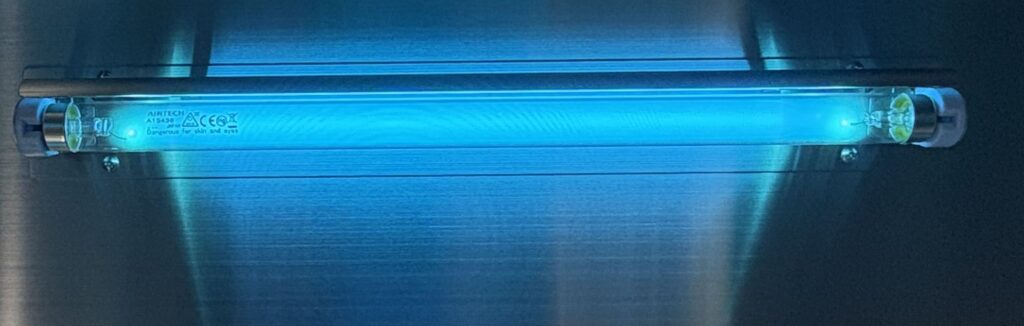
・Ultraviolet irradiation devices (e.g., low-pressure UV lamps, medium-pressure UV lamps, and UV-LED systems)
3. Standards and Regulations
・JWRC Technical Review Criteria for Ultraviolet Irradiation Systems
・NSF/ANSI 55 – Drinking Water Treatment Units – Health Effects
4. Test Method
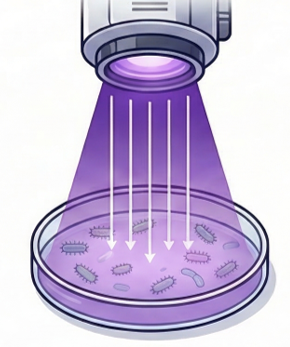
The first-stage test is known as the collimated beam method (or Petri dish method). In this procedure, a known dose of ultraviolet light emitted from the UV irradiation device is applied to a suspension of the test microorganism, after which the number of surviving microorganisms is determined. This establishes the fundamental relationship between UV dose and microbial reduction, namely the correlation between the UV irradiation dose and the logarithmic reduction value.
The second-stage test, known as the flow-through method, evaluates the entire UV irradiation unit consisting of the UV light source integrated with a flow path. A suspension containing the test microorganism is passed through the device, and the numbers of microorganisms before and after passage are determined. This allows the logarithmic reduction achieved during a single pass through the device to be calculated. The resulting logarithmic reduction value is then applied to the dose–response relationship obtained in the first-stage test to determine the UV dose delivered by the device during a single pass.